
Legal and sworn translation
Your official documents, translated and certified by expert translators
Certificates, diplomas, judgments, articles of association: our sworn translators translate your documents with the official value required by authorities, courts and notaries.

















The basics
What is a sworn translation?
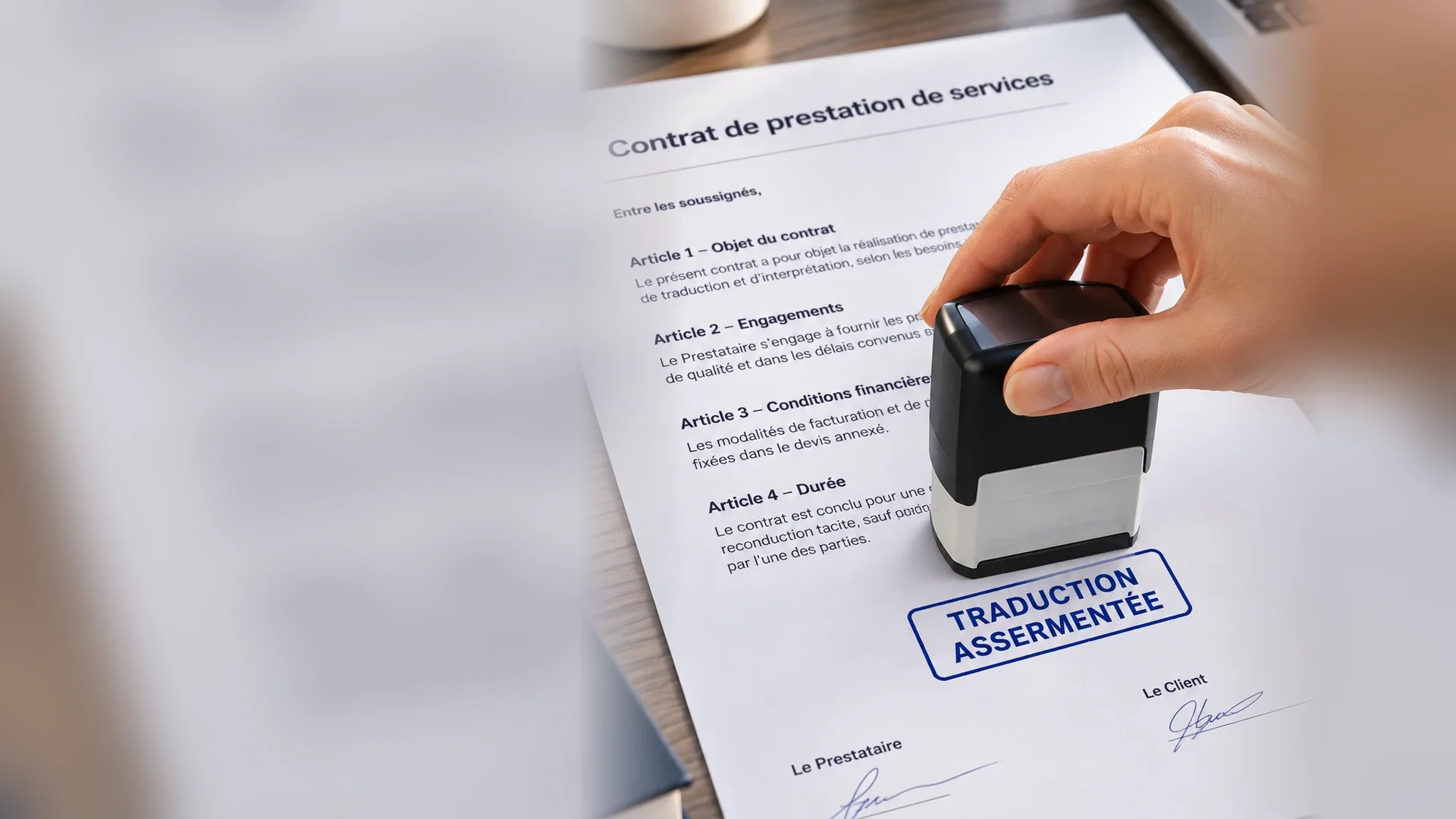
In France, a sworn translation is produced by an expert translator registered with a court of appeal. The translator has taken an oath and is accountable for the accuracy of the translation.
It has official value: it is accepted by authorities, courts, notaries, universities and consulates that require a certified translation.
What a sworn translation includes
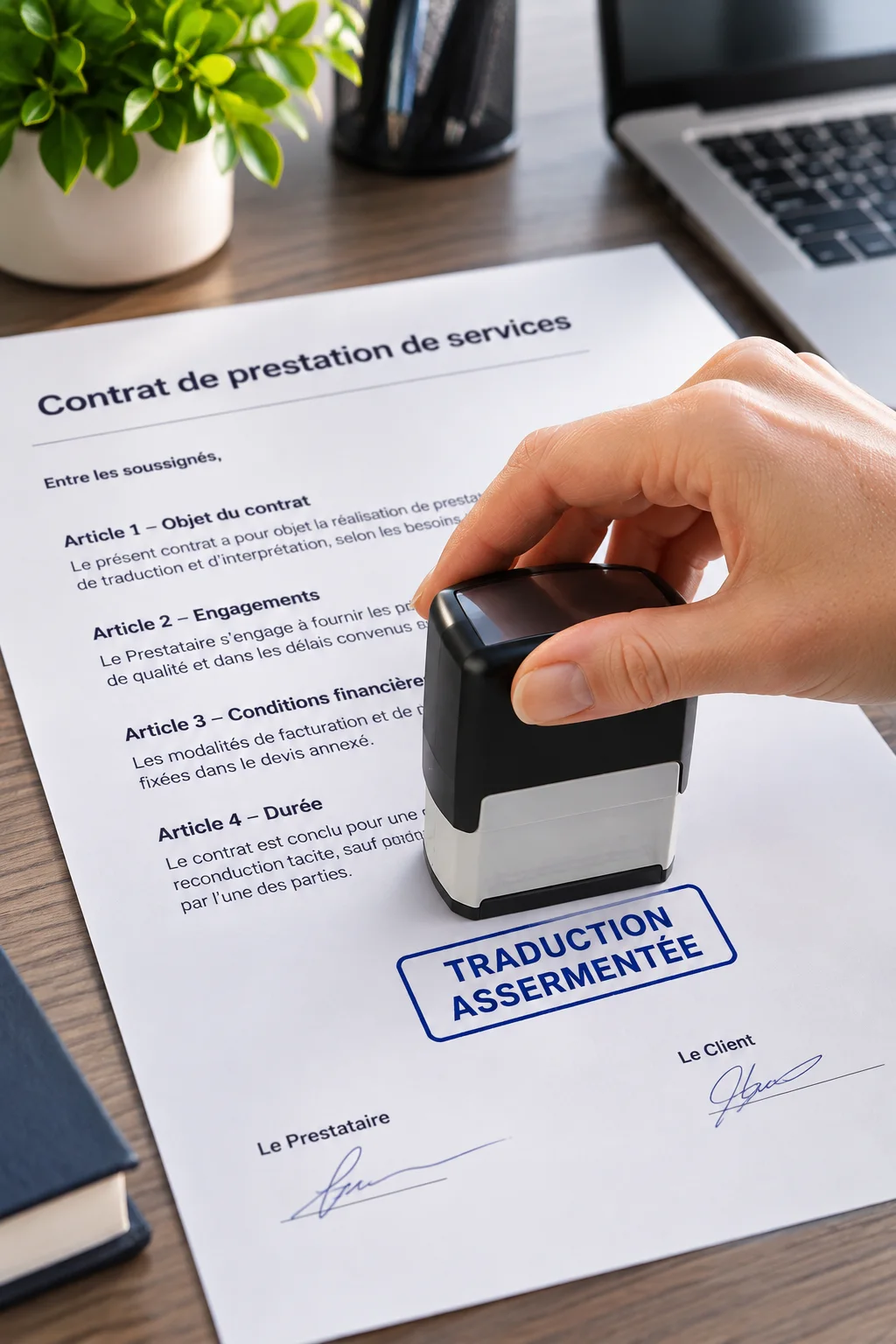
- The expert translator's stamp and signature
- A statement certifying that the translation matches the original
- Every page numbered and initialled
- A copy of the source document, attached to the translation
When?
When do you need one?
Whenever an official body asks you for a translated document, it usually requires a sworn translation.
Individuals
- Birth, marriage and death certificates
- Diplomas, transcripts, certificates
- Driving licences, criminal records
- Marriage, naturalisation and visa applications
- University applications abroad
Companies and legal professionals
- Articles of association, company registration extracts, minutes
- Contracts and commercial agreements
- Judgments, rulings and court documents
- Notarial deeds, powers of attorney
- International tender documents
Our method
How your sworn translation is handled
A precise workflow, from receiving your documents to delivering the certified translation.
- DOCXYour document
 Project managerReceipt of your documents
 Sworn translatorTranslation of the document
- ?Questions / answersNames, dates and mentions clarified
 ReviserProofreading and checks
- AaSpell checkAutomatic check
- Sworn translatorStamp and signature
- Project managerFinal check
- ↓DeliveryPDFStamped, signed PDFOriginal by post
Don't mix them up
Sworn, certified, apostille, legalisation
These terms come up often in official procedures. They do not mean the same thing.
Sworn translation
Translation by a court-appointed expert translator, bearing their stamp and signature. This is what we provide.
Certified translation
In English-speaking countries, the translator attests the accuracy of their own translation. In France, the term usually refers to a sworn translation.
Apostille
A formality that authenticates the signature and seal on a public document, so that it is recognised in the countries party to the 1961 Hague Convention.
Legalisation
The equivalent formality for countries that do not use the apostille, involving the consular authorities of the country concerned.
Apostilles and legalisation are handled by the competent authorities, not by the translator. Check with the receiving body: it will tell you whether the formality applies to the original document, the translation, or both. We are happy to help you work it out.
Languages
Which language do you need?
In practice
Languages, deadlines and delivery
Languages
Our sworn translators cover English ↔ French. For another language, mention it in your request: we will confirm whether an expert translator is available.
Deadlines
The turnaround depends on the language and number of pages and is stated in your quote. Urgent? Call us and we will find the fastest option.
Delivery
Depending on what the receiving body requires: a paper copy bearing the original stamp and signature, a digital version, or both. Let us know in your request.
Legal translation
And when no stamp is required?
Not every legal document needs to be sworn. For internal use, negotiations or information, a specialised legal translation is enough: faster, and carried out by translators trained in law.
- Contracts and terms and conditions
- Compliance policies and charters
- HR documents and internal rules
- Exchanges with your lawyers and partners
Pricing
A quote tailored to each document
The price of a sworn translation depends on several factors. Send us your documents and we will reply with a detailed quote.
Get a free quote- The language pair
- The number of pages and text density
- The requested deadline
- The delivery method (paper, digital)
FAQ
All about sworn translation
Is a sworn translation valid abroad?
It is recognised by the French authorities. For use abroad, the receiving body may also ask for an apostille or legalisation: check with them before starting.
Do I need to send the original document?
Usually a legible scanned copy is enough for the translator. Some bodies, however, require the translation to be made from the original or a certified copy: check their requirements.
How long is a sworn translation valid?
It has no expiry date as such. Some bodies do ask for a recent document, though: check the requirements of the one you are sending it to.
Can I receive my translation digitally?
Yes, if the receiving body accepts it. Some require the paper copy bearing the translator's original stamp and signature: let us know in your request.
Can you certify a translation done by someone else?
A sworn translator only certifies their own translation, so they work from the source document.
What exactly is a sworn translator?
A translator registered on the list of judicial experts of a French court of appeal. Before certifying translations, they take an oath before the court: they undertake to translate faithfully and are accountable for every document they stamp and sign. Their registration is reviewed regularly by the court.
Why can't every translator provide a sworn translation?
Because only an expert registered with a court of appeal can apply the stamp that gives the translation its official value. These translators are relatively few, and even rarer for some languages. We work with them directly and tell you when you request a quote whether your language pair is available.
What does the PDF version contain?
The PDF is a full scan of the sworn translation: every page bears the translator's stamp and signature, with the certification statement and the copy of the source document. It is sent by email. It is the fastest option and is accepted by many bodies for online procedures.
What does the version sent by post contain?
You receive the original paper copy: the translation and the copy of the source document, bound together, with the translator's stamp and handwritten signature on every page. Most authorities, consulates and courts ask for this version when they require an 'original'. Delivery time depends on the postal service.
Can I receive both the PDF and the paper original?
Yes. Many clients ask for the PDF to start their procedure right away, then the paper original for the final file. Just mention it in your quote request.
How many original copies should I order?
One original for each body that requires one. If you need to submit the same document in several places, ask for several originals from the start: it is simpler than placing a new request later.
Does the translator certify that my document is authentic?
No. They certify that the translation matches the document you provided, not that the document itself is authentic. Authenticating a public document is done through an apostille or legalisation, issued by the competent authorities.
Must the whole document be translated, including stamps and the back page?
Yes. A sworn translation covers the entire document: text, stamps, signatures, handwritten notes and the back page. So please send us every page, even those that seem unimportant.
How are names and dates handled?
Names and places are reproduced as they appear on the source document. If a specific spelling must be used (the one on your passport, for example), mention it in your request: the project manager passes it on to the translator.
Is a translation sworn in France accepted in another country?
Often, but not always. Some countries require a translation by a translator sworn in their own country, or an additional apostille. Check the receiving body's requirements before starting; if in doubt, we help you ask the right questions.
An official document to translate?
Send us a copy of your documents and the language you need: we will reply with a quote.